
My understanding of what it means to be Reformed has evolved over time.
To this day, I still wince as I recall the “cage stage” of my Reformed convictions. As a freshman at a broadly evangelical college, I would regularly (and exhaustingly) debate anyone willing to engage me on the doctrines of predestination and total depravity, convinced that I was on the side of the angels. I suspect I was not a terribly pleasant person to be around.
Thankfully, God in his kindness made me aware of an unsettling fact: my Wesleyan, Baptist, and Pentecostal conversation partners were genuinely godly people who often displayed a Christian maturity that put me to shame. Coming to accept this undeniable truth led me out of my “cage stage” into a “chastened stage,” as I began to appreciate how much I could learn from others outside of my own tradition.
As important as that shift was for my personal growth, I eventually needed to take one further step, from the “chastened stage” of being Reformed into what might be called a “grateful stage.” Yes, the Holy Spirit is wonderfully, beautifully at work in every “branch” of his Church. Yet, after many years of pastoring within the PCA, I am now more convinced than ever that the distinctives of the Reformed tradition are extraordinarily valuable—not just for me, but for the health and mission of Christ’s Church.
Grounding
Central to the Reformed tradition is the decision to take seriously how sin has corrupted our minds—our tendency to substitute idols for the true God comes as naturally to us as breathing. This is why the Westminster Confession begins with the doctrine of Scripture. We can only know and worship God rightly because he tells us who he is and how we are to relate to him.
This is also why the Reformed tradition often finds itself holding positions that seem counterintuitive, even offensive. If Scripture teaches that God ordains all that comes to pass—and yet does no violence to human wills—we must accept both as true, even if we cannot fully understand how these fit together. If Scripture pushes us to find unity between the covenants, we will baptize our infants, even if that runs counter to a modern emphasis on personal experience. And it must be God’s instructions, not our own intuitions, that direct our worship. At every level, Reformed theology is a rigorous outworking of sola scriptura.
Identity
At its best, what animates the PCA is not simply a desire to preserve a tradition from the past, but rather a belief that these Reformed distinctives are true and important for the health and wholeness of the Church. While (of course) we want to get our theology “right,” it is about much more than that. We so cherish the Reformed doctrines of grace because they lead our hearts and minds to behold the grace of God and the glory of Christ. Covenantal theology gives us a clearer vision for the kind of Christian community the church is called to be. The Regulative Principle of Worship helps free us from the exhaustion that comes in manmade religion. Part of what unites us as a denomination is the conviction that the Church is more beautiful, and its mission more fruitful, when these Reformed distinctives are given their proper place.
Diagnosis
If you’ve been in the PCA for any length of time, you may have heard that the primary division within our denomination is between the “Truly Reformed” and the “Missionals.” This is unfortunate, because it pits against each other two commitments that need to be interdependent. To be Reformed does not constrain our mission; it empowers it. Our vision of this world being under Christ’s kingly claim drives us outward to all peoples and places. Our convictions about the sovereignty of God and the power of the gospel are what enable us to be bold in our evangelistic and church planting efforts. Our Reformed ecclesiology and sacramentology help form the kinds of churches that can effectively act as the “hermeneutic of the gospel” (to use Newbigin’s apt phrase).
Practice
It seems to me that churches can resemble the three “stages” mentioned earlier. I once attended a church whose emphasis on being Reformed was so central that it was common for members to speak of how they “came to the Reformed faith,” as if it were a second conversion. On the other hand, I’ve also been in a church whose appreciation for the goodness of other traditions meant that, apart from infant baptism, they were virtually indistinguishable from most evangelical churches.
When we rightly value our Reformed commitments, they will be explicitly taught in the catechizing of our youth, in new membership classes, and in leadership training. Perhaps even more importantly, a church that is healthily Reformed will have worked through the implications of these convictions in all aspects of ministry—not only in what is preached, but also in the shape of the service, the structures of leadership, and in how Christian growth is pursued. Yet such a church need not frequently foreground its Reformed identity in its worship services. What drives us in our commitments is not a desire to celebrate our Reformedness, but rather a passion to more fully focus our attention on the glory of God in Christ.
Looking Forward
My longing is to see our denomination move past the polarization that has more to do with the influence of our present culture than it does with the gospel. We will only flourish as those with theological and practical giftings learn to appreciate and depend upon each other.
Our current disagreements have less to do with how Reformed our denomination needs to be and more to do with competing visions for how that Reformed identity should be expressed. By at least one account, three distinct visions are at play. Some believe the PCA’s pathway forward involves continuing and preserving the Southern Presbyterianism of the old PCUS. For them, to be Reformed involves maintaining relatively homogenous styles of worship across our denomination. Others appear to be in favor of a kind of hybrid Reformed-evangelical denomination. To be Reformed in this case primarily relates to one’s view of salvation and sacraments, while most other practical ministry decisions are largely shaped by modern evangelicalism.
If we want to be a denomination that is genuinely Reformed and yet also that transcends human divisions of class and race, neither of these is adequate. The only vision for our Reformed identity that is up to the task is the one that the PCA has had from its beginning: to be a conservative and confessional mainline denomination committed to Reformed catholicity. The way forward for the PCA is to be thoroughgoingly confessional while also being deeply culturally engaged.
What would you say to a pastor who wants to be faithful to this commitment but feels weary or discouraged?
In my experience, pastors in the PCA are not discouraged by Reformed commitments in general. Rather, the challenge is felt especially in the political dimension of participating in this project. How do we work together with those who have conflicting understandings of what it means for the PCA to be a Reformed denomination? Often daunted by the slow and even confusing processes of denominational deliberation and unsure of how worthwhile it is to engage in it, many capable leaders in the PCA have absented themselves from General Assembly.
That this is so common is itself a reason to be encouraged. The version of the denomination we see in social media, and even, to a lesser degree, what we encounter at GA, does not accurately reflect who we as a denomination truly are. What might it look like if not just one, or two, or a dozen, but hundreds of those who previously checked out decided instead to actively pursue the kind of Reformed denomination that originally attracted us to the PCA? Personally, I would love to find out.
To be Reformed means we believe in a sovereign God who always is working his grace in and through our deeply flawed decisions and processes. We in fact believe that it is often where we appear weakest that God chooses to show his greatness. This means that, as we pray, we can engage with hope in the messy work of being a denomination. We don’t know what God will do or where he will take our denomination. But we can be confident that the labor we offer in service to the One who ordains all things will never be in vain.
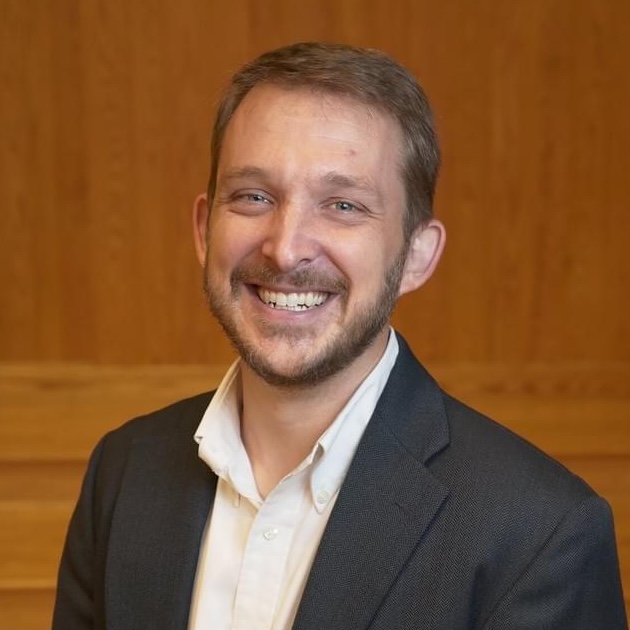
Geoff was born and raised outside of Boston but now feels very much at home in the Chicago area (although he stubbornly remains a Red Sox and Patriots fan). He and Jennifer and their three boys enjoy being a part of the Hinsdale community. Geoff is passionate about seeing many experience the life-changing love of Jesus, and he feels privileged to be a part of a church family where this is happening.
Geoff received his seminary degree from Moore Theological College in Sydney and his Ph.D. in theology from Wheaton College. He is the author of Free to Be Sons of God and the Galatians study from Crossway’s Knowing the Bible series. Geoff has been senior pastor at Trinity since 2009.