


Worship is formative, like it or not. The songs we sing in church, or in a ministry like RUF1 express the DNA of our group (“Is this a safe place to admit my struggles?”) and they reflect our understanding of what the normal Christian life feels like. Of course singing is a way to pour out our hearts to God, and (hopefully) engage our minds and bodies as well. But the songs we sing are always shaping us as image bearers, whether we are aware of this or not. If this is true, it means we must attend more carefully to what we do, say, and sing in our times of gathered worship as Christians. I have believed this for many years, and my conviction of how vital this is has only grown during my time in campus ministry.
Early on in my work with students at Belmont (a Christian liberal arts school with a Baptist heritage and a strong emphasis on music and music business programs), I found myself having a regular conversation with students from Christian backgrounds. We would typically be sitting at Bongo Java, enjoying the coffee, and the iconic tabletop artwork, and students would share their doubts about whether they were actually truly believers. Now, this isn’t an inappropriate question, and in fact the Bible encourages us to “make our calling and election sure” (2Peter 1:10) – and ministering the doctrine of assurance is an important part of pastoral work (and one that I fear is not emphasized enough in many seminaries.) What began to concern me though, was the reason so many of the students were struggling with this question. As I explored a bit, I often found they were experiencing significant doubts since they had come to college; doubts that surprised and even frightened them. Doubts about the veracity of the claims of Christianity in some cases, but more often doubts generated by not feeling close to God. And it wasn’t just the doubts that were the cause of their spiritual distress, it was the meaning they were making from these confusing feelings.2
They had concluded that if they were not “fired up” for Jesus, like they had been in high school, then perhaps they were not truly Christians at all. My friend Bill Boyd, former RUF campus minister at UT at Austin, used to say that nearly every student he met with was trying to get back to a mountain top experience they had at middle school camp. Many of my students were the same.3 As I probed why they believed their lack of consistent feelings of love for Christ were an indication that perhaps they were not truly saved, it became clear that at least some of this was being generated by the songs they were singing – songs that were lying to them about what the normal Christian life feels like.
I would ask, “Have you ever read the Psalms? Because what you are describing seems like a pretty regular experience for people of faith as expressed in the Psalms?”4 But it became quickly obvious that while some had read in the Psalms, most had not really read the Psalms. And they certainly had almost never sung the Psalms, at least not the full Psalms, including the uncomfortable parts. However, I began to realize that it was the songs they were regularly singing in youth groups, and their churches that were a big part of the problem. As I said, worship is formative, like it or not, and many of my students had been malformed by songs that were lying to them about the normal experience of Christian believers.
If we only ever sing songs about how we feel – and if the only feelings we sing about are love and devotion for God – then what happens when you open your eyes in the midst of the crowd, look around the room and admit to yourself, “I’m not really feeling this…”? It is a profoundly alienating experience. I believe that we can and should sing songs about how we feel about God – the Psalms are full of this. But we also need to regularly sing songs about how God feels about us – and why! And that is what Paul teaches in Colossians 3 – singing together is one of the ways we get the Word about Christ, the gospel, the good news of the peace God has wrought, to dwell in and among us richly! Worship is formative.
Augustine is credited with the quote, “He who sings, prays twice.” While scholars have not been able to find this exact quote in his writings, the idea is eminently biblical (and Augustinian.) We need the gospel to dwell in our hearts richly as Paul says. But sadly, Colossians 3:15-17 is one of the more misunderstood passages in scripture. The heart in the Bible is not where your feelings reside – you feel things in your bowels Biblically speaking. So Paul is not saying here that we just need “peaceful easy feelings”, rather he is saying we need the gospel to dwell at the center of our community, and rule over our feelings, prejudices, and social taboos because this peace (an objective reality which Christ has wrought) has reconciled us both to God and to one another in Christ. (cf. Ephesians 3:13-19, a parallel passage to Colossians 3). In other words, we should sing to God about how we feel – but we must remember that the Bible says that singing is not just a way to express our feelings toward God in worship – singing is an essential means through which the gospel comes to dwell in us richly – to dwell in us not merely as a theological fact, but as an animating soul-stirring treasure. I came to realize that if I wanted my students to grasp this, we needed to find some better songs to sing. We needed songs that are more honest about struggle, and more explicit about the gospel.
When I was in college, I went through a period of questioning what I really believed. I was at Berklee College of Music in the 1980s, and Boston back then was a great place for used bookstores. I spent hours searching for books that might help me and one of the things I discovered was an essay by CS Lewis, “On The Reading Of Old Books.” It profoundly shaped me because it named what I myself was experiencing. Lewis argued that one of the best way to see past our own cultural blinders was to read two old books for every new book one read. In my scouring of used bookstores for treasures I was regularly finding that the older books, like JC Ryle’s “Holiness” and “The Memoirs And Remains Of Robert Murray M’Cheyne” (both 19th century titles) were so much more helpful than many of the modern Christian books I had consumed. It was through older books like these that I came eventually to understand the freedom and joy of the doctrines of grace. And since those days I had regularly turned to older authors for spiritual nutriment. I never actually thought I would go to seminary and so I amassed quite a collection of books to help me learn and grow. Somewhere along the way, I had picked up a few old hymnals and I began to search in them for songs that were more honest about struggle and explicit about the gospel to help my students.5 If worship is formative, and I was convinced that it was, then we needed to find the kinds of songs that would form us well.

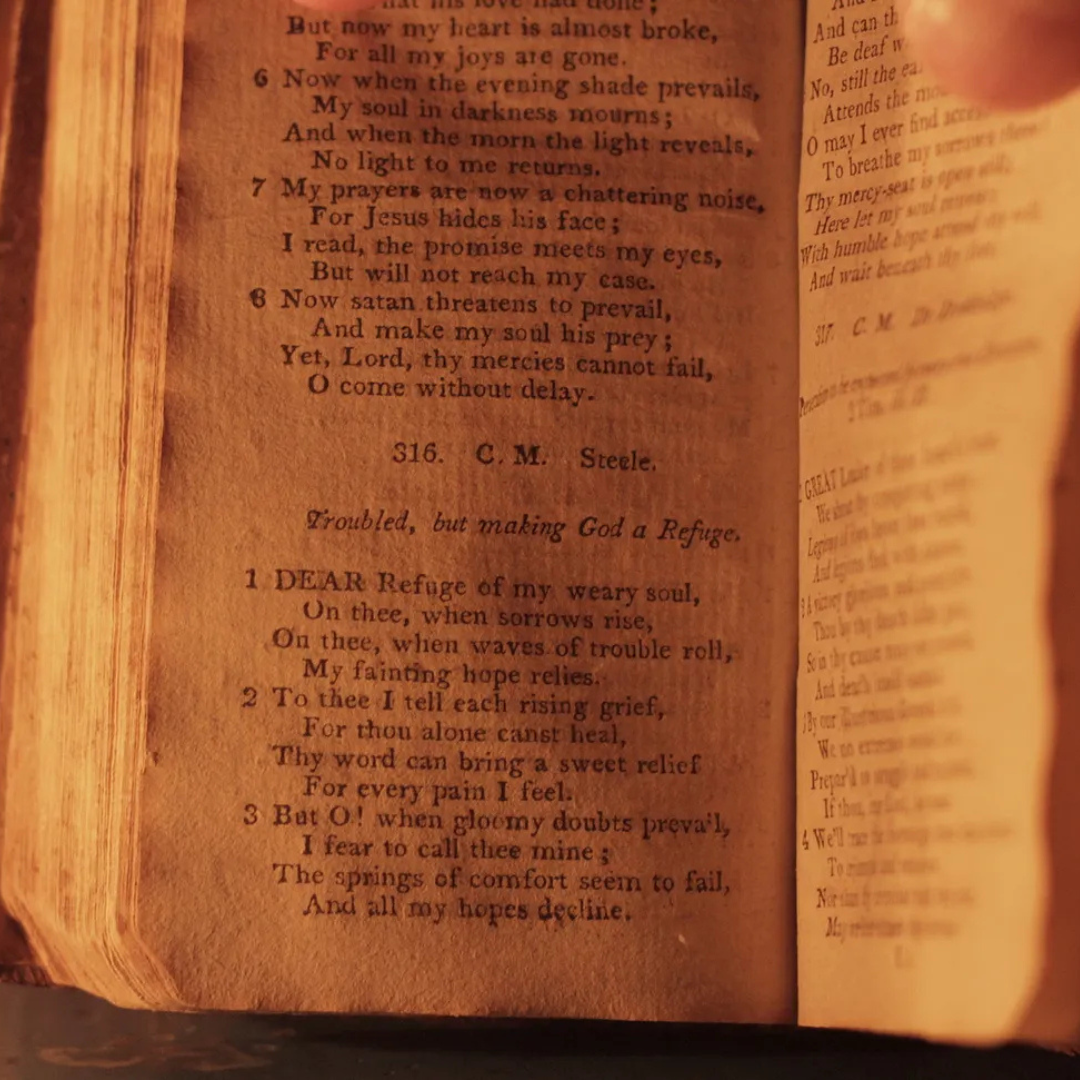
I found some of them in an 1807 copy of John Rippon’s collection.6 This was a book I discovered in an antiquarian bookshop in Atlanta back in the early 1990s. It drew attention on the shelves because of the way it had been repaired (well over 100 years ago) with a piece of leather. (It is not unusual to find old hymn books literally worn out through years of use.) This was a book of hymns with stories to tell and scars to prove it. Now, what many might not realize is that most hymn books from before the mid-19th century do not have tunes included in them – they are collections of texts and typically people would sing most of the hymns to a handful of tunes.7 I often explain that if you know a tune for Amazing Grace, Rock Of Ages, and Come Thou Fount you can probably sing half the hymns in most of these old books. But one of the hymns I found in this book was to change my life, literally. Hymn #316 was titled “Troubled, but making God a refuge” and the name Steele was attached to the hymn. You likely know this hymn by its first line, “Dear Refuge Of My Weary Soul.” and as I later discovered, it was written by the 18th century English Baptist Anne Steele.8
Who would write a song with a title like “Dear Refuge of My Weary Soul”? We were NOT singing songs like that in any church I knew. Certainly I had never heard songs like that on Christian radio either!9 But it wasn’t just the fact that we weren’t singing songs like this in church which struck me. What arrested my attention was the fact that this hymn expressed what my students were feeling – and what they were afraid to say out loud. And yet, this song was in a hymnal put together by a pastor who believed songs like this were not just allowed, but helpful! What happened to these kind of honest songs? Could we sing songs like this today? I felt that we had to try.
I began finding more great texts as I searched in old hymnals, and sometimes I would bring them into our college Sunday School class at Christ Community Church, or to our Belmont RUF gathering. I would have a copy of the words printed and as I handed them out I would announce, “We can sing this one today to the tune for Come Thou Fount, but if someone wants to write a tune this week we can sing it next week with a new tune.” And, because we had so many gifted songwriters in our group of mostly Belmont students, they took me up on it! Eventually I found that I copies of Gabsby’s hymns and Spuurgeon’s Our Own Hymn Book from a place in Montana and I would give these books to my students. After a while, we had gathered enough songs that we thought maybe we should make a CD. Some of the other RUF groups (like the chapters at Auburn and Texas A&M) had made CDs around this time. My own background was in recording engineering, it was what brought me to Nashville in the late 80s, and I had a friend graciously offer us use of his studio for free. So what was originally going to be a simple guitar and vocal project quickly grew in scope to become a 17 song project with a full band. Indelible Grace Music was born. We put 17 songs on that first CD because we didn’t plan to make another one. But the incredible response to that record revealed we were not alone in wrestling with the lack of honest songs for the church.
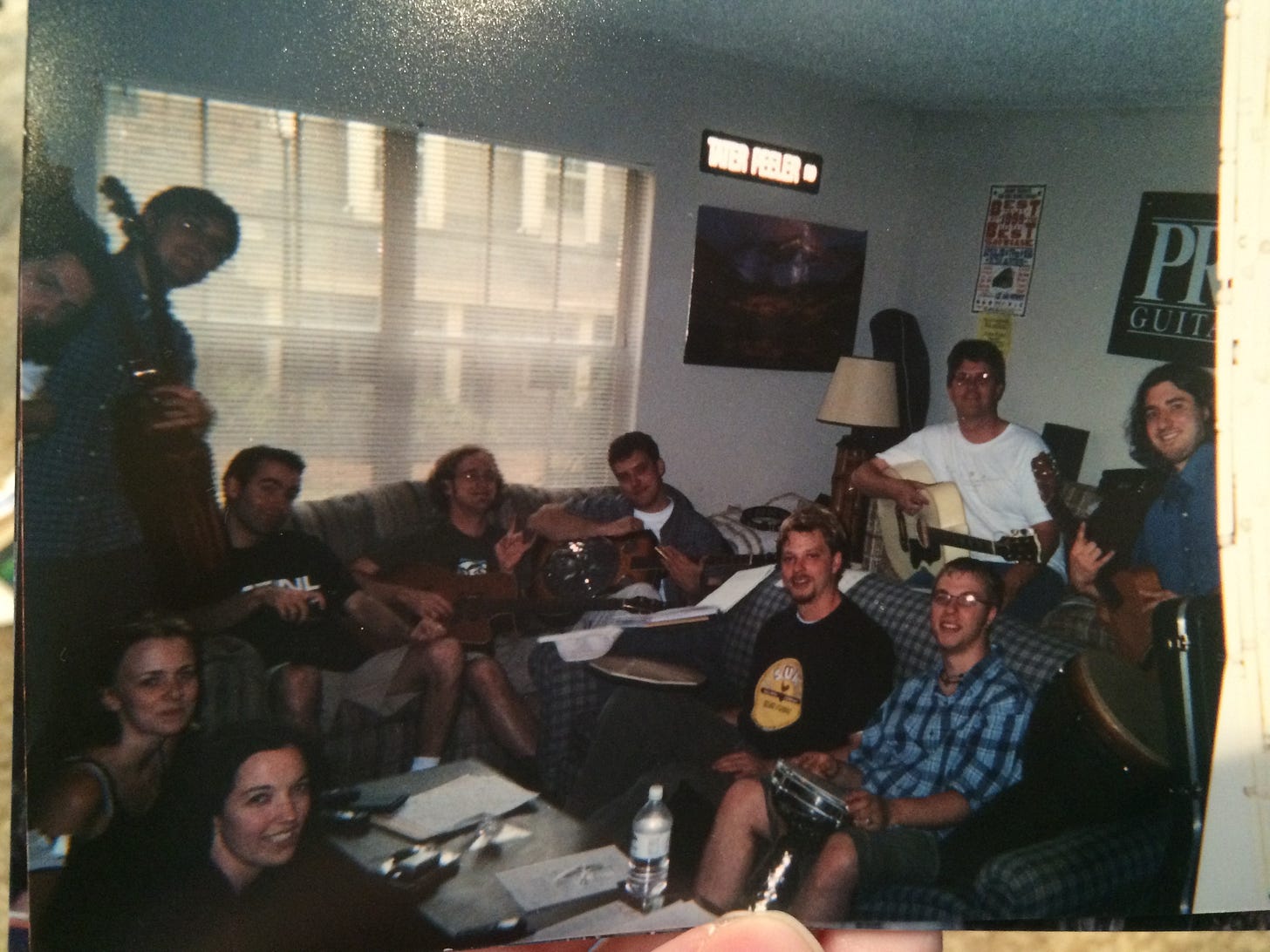
Some of the “old Indelible Grace gang” in 2002
I tell people, Indelible Grace is really a group of friends who fell in love with these old hymns and wanted to share that with the world. It is more complicated than that of course, but in many ways that has always been at the heart of it. It arose from a pastoral call to attend to the way songs were shaping college students. It was part of a larger movement within RUF groups around the country, but our Belmont RUF group had some particular gifts to offer the church. Of course, as Bill Lane used to say, when God wants to give us a gift He generally wraps it up in a person. And that brings me back to the present day.
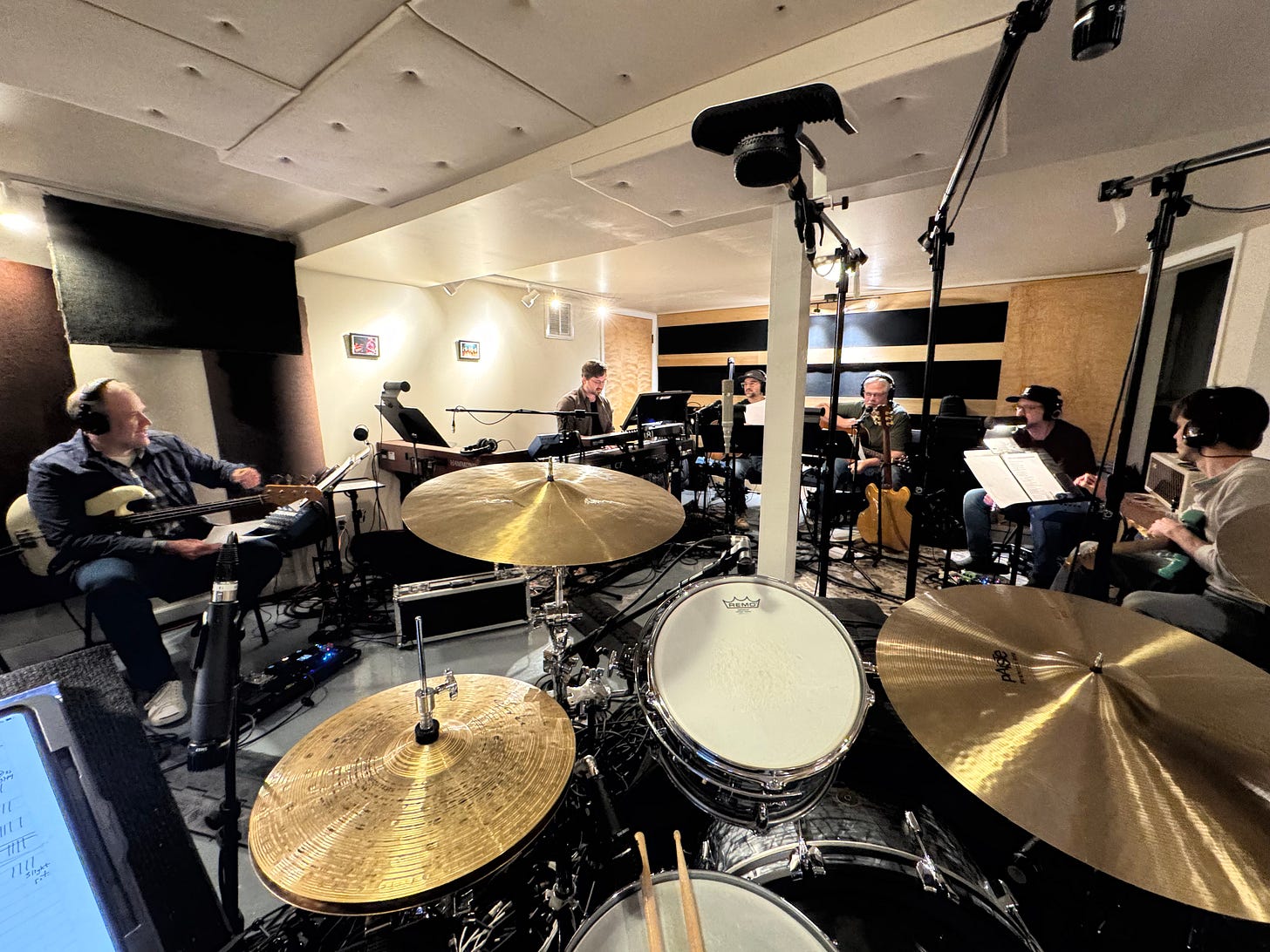
What a blessing to have friends like this with a place like Paul Eckerg’s to rehearse and record! (We tracked our new Indelible Grace record here too back in the summer)
Last night as we gathered the incredible band of RUF alums that will play for the hymn sing on Saturday night; and as we rehearsed hymns some of which we have been singing and playing for 30 years, it struck me again of how God has given us some really beautiful gifts. It’s not just the hymns, but the community that has formed around these songs and the work of making these records to share with the world that has been one of the greatest gifts I have known. Of course, as I reflect on the stories of the last 30 years, there are joys and tears. But as I am regularly reminded, the story is not over yet and so I live with hope and profound gratitude for the way these 30 years of RUF ministry have shaped me and our community. My prayer is that tomorrow night will be a tangible reminder of God’s indelible grace at work in the past and a foretaste of what is still to come. To that end we will be singing hymns from that very first project that released in 2000, with some of the artists who have been part of this sing since the beginning. But we will also be including some of our more recent RUF alums (and even one current student!) who have been an important part of the latest project which is still being released. We love to use the image of roots and wings (rooting our students in the church that is bigger than people than people that look and sing like them) and inviting them to add their own voice) and I hope that will be beautifully portrayed.
Grace and peace, Kevin Twit
1 Reformed University Fellowship, the campus ministry of the Presbyterian Church in America (PCA) in which I have served for 30 years at Belmont University in Nashville
2 I have to credit my wife Wendy, a licensed therapist and RUF staff worker for naming this so well.
3 For more on this I highly recommend John Newton’s letters on the stages of growth in the Christian life – the first three letters in the paperback collection published by Banner Of Truth.
4 I have always loved John Calvin’s description of the Psalms as an “anatomy of the soul” in which all of the emotions common to mankind are expressed. See Dan Allender’s wonderful book “The Cry Of The Soul” for more on this.
5 I was not alone in this, within RUF circles there was a growing movement of singing old hymns, and setting them to either familiar folk tunes or composing new tunes for them
6 I did not know at the time anything about John Rippon, I have since learned much more about him and the hymn writers in his collection and hope to share that in future essays.
7 There was a tune book published to accompany some of these hymn books and I have a copy of the tune book for Rippon’s hymn book – a pretty scarce book that took years to find.
8 While it is difficult, I am going to resist the temptation to talk more about Anne, my favorite hymn writer, right now. Trust me, I have much more to tell about her and the impact she has had on me and the Indelible Grace movement.
9 [Full disclosure: In the 1980s I worked in a Nashville recording studio on many CCM records and played in a band that even won a Dove award, so I knew that world fairly well.
Originally posted to Kevin Twit’s Substack.
Kevin Twit is the RUF campus minister at Belmont University in Nashville, where he has served for over 30 years. He is the founder of Indelible Grace Music, a movement dedicated to recovering rich hymn texts and setting them to new music for the church. Through his ministry, Twit has sought to help students and congregations engage more deeply with the gospel through honest, theologically grounded worship.