

Frank Houghton was newly ordained as an Anglican deacon and priest just as World War I was ending. He served two curacies, one in Liverpool and the other in Preston, and was already known as an evangelical in a church that was becoming ritualistic. But in 1920, his life changed forever when he picked up a copy of the life of Hudson Taylor, the famous founder of the China Inland Mission. Fired by the challenge of international missions, he willingly left everything in England and went to China over the objections of his doctor who worried over his heart issues.
After a forty-day trip at sea, he arrived at Shanghai. Immediately, he was shocked by the unbiblical paternalism exhibited by his English colleagues, who refused friendship to their Chinese brothers and sisters who served beside them. He was determined to go a different way and related to everyone as a brother in Christ. Four years after he arrived, he became principal of the Theological College in Paoning, Sichuan province, and would also edit the newspaper China’s Millions.
It was in this role as editor of a religious newspaper that he began to write verse. One such poem that would be set to music was “Facing a Task Unfinished.” Later, in 1934, after John and Betty Stam were martyred, he determined to visit the various missionary centers to make sure that all was well. As he traveled over the mountains of Szechwan, he meditated on 2 Corinthians 8:9, “Though he was rich, yet for your sake he became poor.” And as he thought on those words, Houghton would write the following verse:
Thou who was rich beyond all splendor,
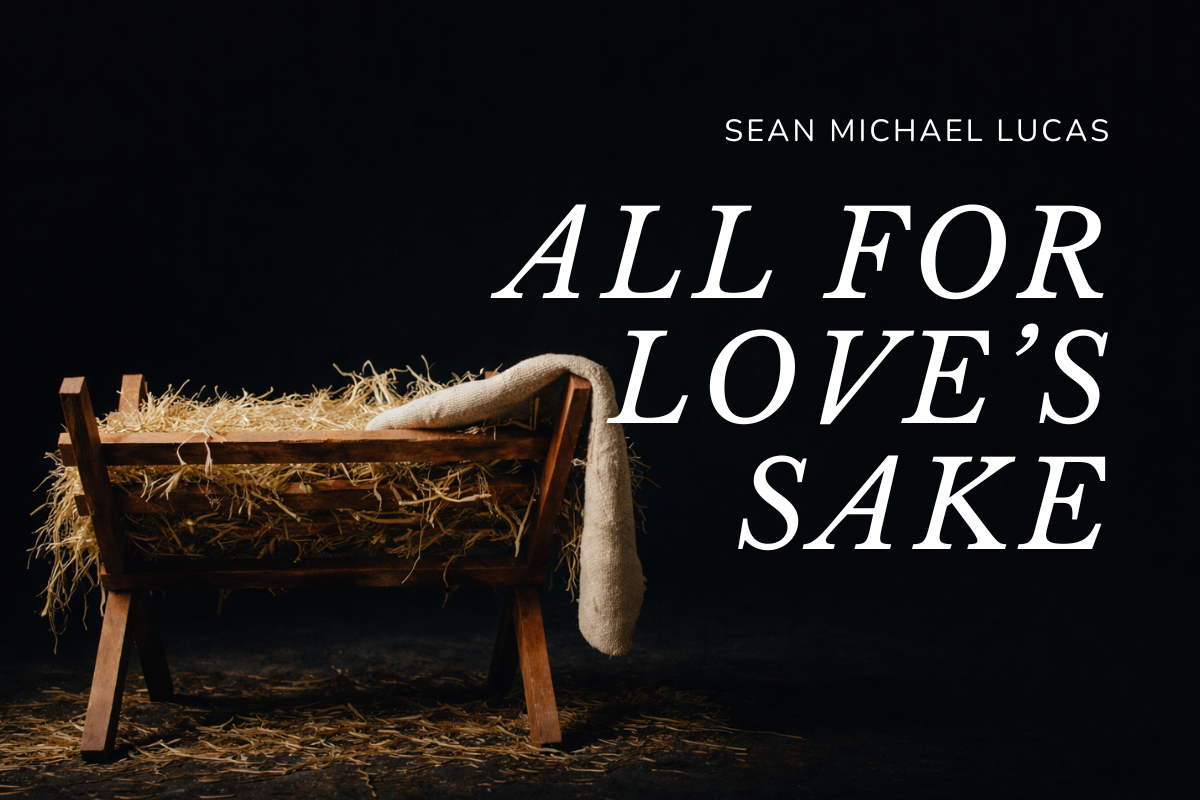
All for love’s sake becamest poor;
Thrones for a manger didst surrender,
Sapphire-paved courts for stable floor.
Houghton knew this Jesus who was rich beyond all splendor, who for love’s sake became poor, dwelt among his own, suffered, bled, and died that we might be rescued. And because Houghton knew Jesus lived this way, he followed in Jesus’s path: he too forsook thrones, churches, courts to tell the Chinese about Jesus. He did it all for love’s sake.
When we think about Advent and Jesus’s incarnation, we must never rush past the fact that the God of glory, the Lord of Creation, “the Word became flesh and blood, and moved into the neighborhood” (John 1:14 Message). When the eternal Son of God took on human flesh, took on the role of a servant, he condescended from the greatest imaginable heights. And he did it all for love’s sake.
Our Catechism talks about Christ’s condescension, his humiliation, in these terms: “Christ’s humiliation consisted in his being born, and that in a low condition, made under the law, undergoing the miseries of this life, the wrath of God, and the cursed death of the cross, in being buried, and continuing under the power of death for a time” (WSC Q27). During this season, we remember the first part of the answer: the Lord of glory was born. He was in the womb of the virgin Mary; he came through the birth canal; he was a helpless child. The God upon whom we are all dependent was himself dependent upon Mary for life itself.
If that wasn’t humiliation enough, he was born in a low condition. A stable floor, a feeding trough, a migration from Nazareth to Bethlehem to Egypt—in his first two years, that is what Jesus knew. The God who rules the universe, who sits upon the throne of heaven, was ignored and then threatened by the earthly powers over whom he reigned.
This is the God who owns the cattle on a thousand hills, claimed the diamonds yet to be discovered in Zimbabwe, knew where the deepest gold mines of South Africa were, had every oil reserve on this planet in his portfolio and every waterfall and aquifer mapped in his mind. How rich—beyond the richest corporation in this world today!—was this God. And yet, he took on flesh and blood as a Palestinian Jew, as a child of a man who worked in wood and stone, in a forgotten town called Nazareth.
And thirty years after he was born, he would make his way to Jerusalem, riding on a donkey as the true King of God’s People. He would be tried on false charges, convicted by two courts, and crucified between two thieves for the sins of the world. The richest possible Being in the world became abandoned, destitute, poor—and he did it for you, for your salvation, for your transformation, for your eternal rest. And he calls you to follow him, to do the same—even if it means forsaking everything and going to a faraway place with only the Gospel in hand. Like Frank Houghton, who would serve in China for thirty-three years.
All for love’s sake.